
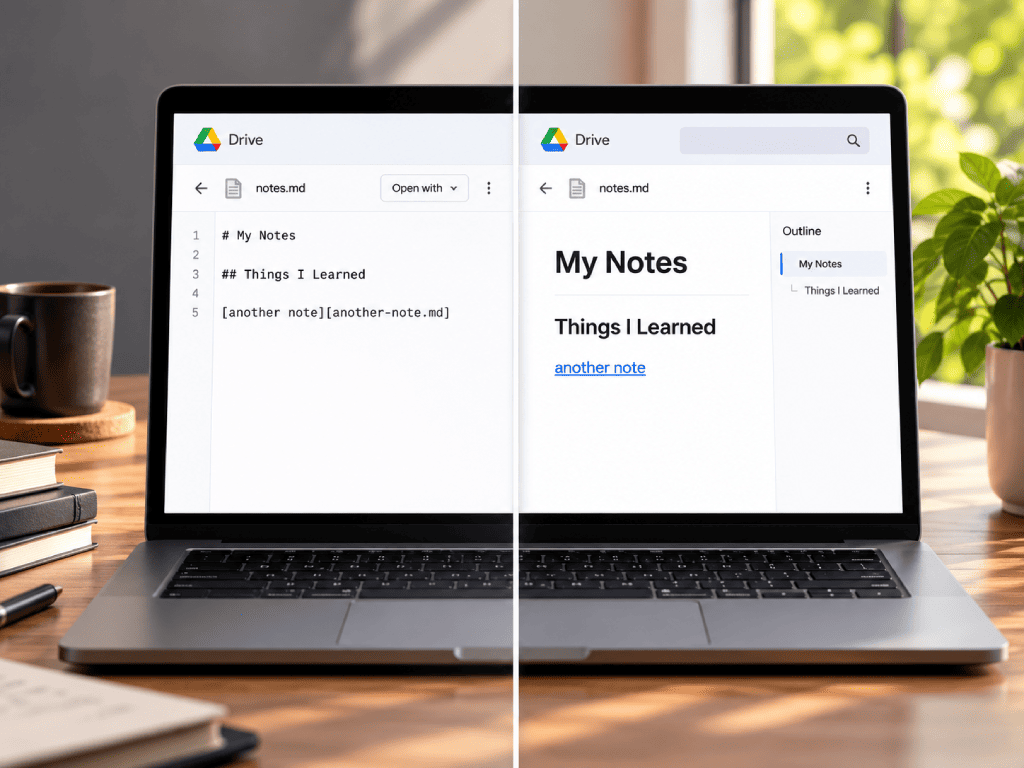
I’ve been keeping a lot of my notes as Markdown files for years. I started using it because it was simple and convenient, but over time I realised there was another advantage. The files are mine. They don’t belong to an application. They are just text, so I can open them almost anywhere, search them, move them around, or give them to another tool.
I keep them in Google Drive because I want them available everywhere. This works well until I want to actually work with them in Drive.
If I click on a Markdown file in Drive, I get something like this:
# My Notes

## Things I Learned

[another note](another-note.md)
That’s it.
The headings aren’t headings, the link isn’t a link, and there is no outline. Drive doesn’t seem to know that the file is a document at all.
And if I want to edit it, things get even stranger. Drive gives me the option to open the file with Google Docs, but that creates a new Google Doc and leaves the original Markdown file behind. I’m no longer editing my Markdown file. I’m creating a different document from it.
To edit the actual .md file, I have to use a third-party application. Google Drive has been around for more than a decade, and Markdown isn’t exactly an obscure format anymore.
Markdown Is Becoming More Interesting
In fact, I suspect Markdown is becoming more important because of AI.
Markdown happens to be unusually well suited to AI-assisted work. Ask an LLM to write a document and it will happily produce headings, lists, tables, links and code. Ask it to modify a document and it can work directly on the text. Ask it to compare two versions and you can diff the files.
It has enough structure to give text meaning, but very little machinery around that structure. A heading is a #. A list is a -. A link is some text and a URL. There isn’t much else to understand.
That makes it useful in a workflow where humans and machines are working on the same information. You can have a folder of Markdown files and ask an AI to read them. It can create new ones, modify old ones, summarize them, reorganize them or turn them into something else.
Applications like Obsidian fit this model particularly well. The application gives you a useful interface to your notes, but the notes themselves remain ordinary files. You can leave Obsidian without having to leave your data behind.
An LLM doesn’t care whether a note was written in Obsidian, a text editor or something else. It cares whether it can understand the file. The same files can be used by different tools, each providing a different way of working with them.
This is quite different from the traditional document model, where the application was tightly connected to the document. A Google Doc lives inside Google Docs. That makes Google’s treatment of Markdown a little harder to understand.
Google Already Understands Markdown
Google already knows how to work with Markdown. Google Docs has supported Markdown import and export since 2024, and Gemini produces Markdown all the time. So this isn’t a case of Google not knowing the format. The company can read Markdown, convert it into other representations, and generate it itself.
What is strange is how Google treats the Markdown file itself. Drive doesn’t treat it as a first-class file type. You can view the raw text, or open it with Google Docs, but that takes you into a different document format rather than letting you edit the .md file itself.
There is a reasonable explanation for that.
Google Docs and Markdown solve different problems. A Google Doc is a structured, collaborative document. That’s what allows several people to edit it at once, leave comments, suggest changes and maintain a detailed history. Markdown can’t do most of that.
But nobody is asking Google to replace Docs with Markdown.
The expectation is much simpler. If Drive contains a Markdown file, why not treat it like one? Show the heading as a heading, render the code block, make a link to another file clickable, and give me an outline. If I edit it, save the changes back to the same .md file. Don’t turn it into a Google Doc or change the file format. Just let me work with the file I already have.
The technology isn’t particularly novel either. Plenty of applications already render and edit Markdown files, and browser extensions can add the missing preview experience to Drive.
So the interesting question isn’t whether Google can do it. The question is why it doesn’t make Markdown a first-class file type in Drive.
Maybe Nobody Owns It
Drive owns files. Docs owns documents. Google’s AI products have their own teams and priorities. But who owns the experience of someone who has a folder full of Markdown files and wants to view and edit those files in the browser without converting them into something else? It doesn’t fit neatly anywhere.
This is one of the problems that gets harder as companies get bigger. Important projects have owners, roadmaps and priorities. A problem that sits between several products without becoming any one of them is much easier to postpone.
That doesn’t mean this is definitely why Google hasn’t built it. There may be technical or product reasons that aren’t visible from the outside. But it is a plausible explanation for why an apparently small, well-understood problem can survive for years.
When a company fails at something extremely difficult, the explanation is usually straightforward: the thing was difficult.
When the technology is well understood and the problem is already being solved elsewhere, but no product seems to own it, you start looking somewhere else.
Maybe it is priorities. Maybe it is incentives. Maybe it is organizational boundaries. Or maybe the problem simply never becomes important enough for someone to own.
I don’t know which explanation applies inside Google. But that, to me, is the interesting question: why doesn’t Google Drive understand Markdown?



 When AI Does the Work